Book
The Real Estate Millionaire
How to Invest in Rental Markets and Make a Fortune
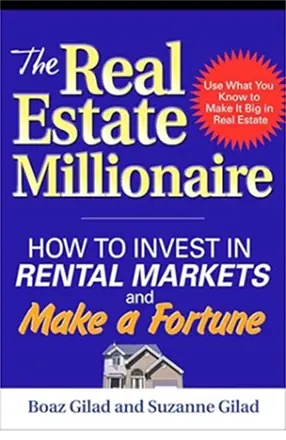
The Real Estate Millionaire, published by McGraw-Hill, is Boaz Gilad's practical guide to rental-market investing, drawn from decades of buying, renovating and operating properties in difficult markets. It covers finding, financing and managing rental property, and building the systems that let a portfolio run without you.
The playbook
What you'll learn
- 01Market and neighborhood evaluation
- 02Deal sourcing, negotiation and underwriting
- 03Renovation and value creation
- 04Portfolio operations and cash flow
- 05Systems for sustainable returns
Who is it for?
First-time rental investors, portfolio operators scaling up, entrepreneurs diversifying income, developers and brokers who want the investor's view.
From The Performance File
Investing discipline, in Boaz's essays
On Future Trading
Gilad observes that the mind is almost never fully present, constantly reviewing the past or predicting the future, and argues that nearly every meaningful action is effectively a 'trade' placed against an unknown future despite that uncertainty. He frames decisions—starting a business, committing to a relationship, making an investment—as bets on outcomes we cannot guarantee, and suggests the goal isn't to eliminate this uncertainty but to trade more wisely: building in systems, boundaries, reserves, or alternate paths that reduce fragility if a particular bet doesn't pay off. The essay cautions against two failure modes: either freezing in place out of fear of an unknown future, or recklessly betting an entire life on one single outcome without protection. Gilad emphasizes that genuinely engaging with the future requires concrete present-tense action rather than abstract thinking, talking, or fantasizing about it. He closes with a call to identify what one specific action—a call, a decision, a difficult conversation, a financial move—would make a desired future more real today, framing future trading as the future entering the present through deliberate action rather than imagination alone.
Read the summaryOn Planning
Opening with Mike Tyson's line about everyone having a plan until they get punched in the mouth, Gilad challenges the illusion that careful planning can eliminate uncertainty or guarantee a predictable path, arguing that this belief keeps people stuck chasing an impossible level of control before they're willing to begin. He reframes the purpose of planning: not to remove surprise from life, but to prepare a person to execute, adapt, and keep moving once reality inevitably diverges from the plan. The essay introduces a visualization exercise in which readers imagine their ideal future as a documentary—describing in vivid, concrete detail how they move, what has changed, and what success looks like, as though it has already occurred—then work backward to identify essential milestones, breaking them into weekly and daily actions. Gilad insists the work should begin immediately, 'not when it feels perfect,' while staying flexible as reality unfolds. He closes by distinguishing the goal of planning from blindly following a fixed plan: real planning builds the capability to adapt and arrive despite uncertainty, rather than promising a smooth, uninterrupted path.
Read the summaryOn The Long Game
Gilad challenges the common assumption that life consists of separate, sequential victories—win the business game, then relax; fix the body, then move to relationships—arguing instead that all of life's 'games' are interconnected, and success in one area while neglecting the system that supports it quietly undermines long-term performance. The essay frames top performers as people who understand that the long game is already underway, not a future event to prepare for, and that today's seemingly minor choices in health, relationships, and finances are training ground for challenges that haven't yet arrived. Gilad provides specific example commitments—quality time with a partner without devices, weekly financial review, morning journaling, leaving work at a set hour—as concrete ways to invest in the interconnected system rather than a single isolated goal. He asks readers to identify which current challenge is secretly training them for a future game and to act on that insight immediately rather than deferring it. The piece closes by replacing the common delaying thought 'I'll handle it later' with the reminder that today, not later, is where top performers actually train.
Read the summaryQ&A
Questions about the book
Invitation only
The room changes you.
Zenith is invitation-only. Every application is read personally.