Coming soon · November 2026
The Road Was New
A Story of Failure, Reinvention, and Becoming
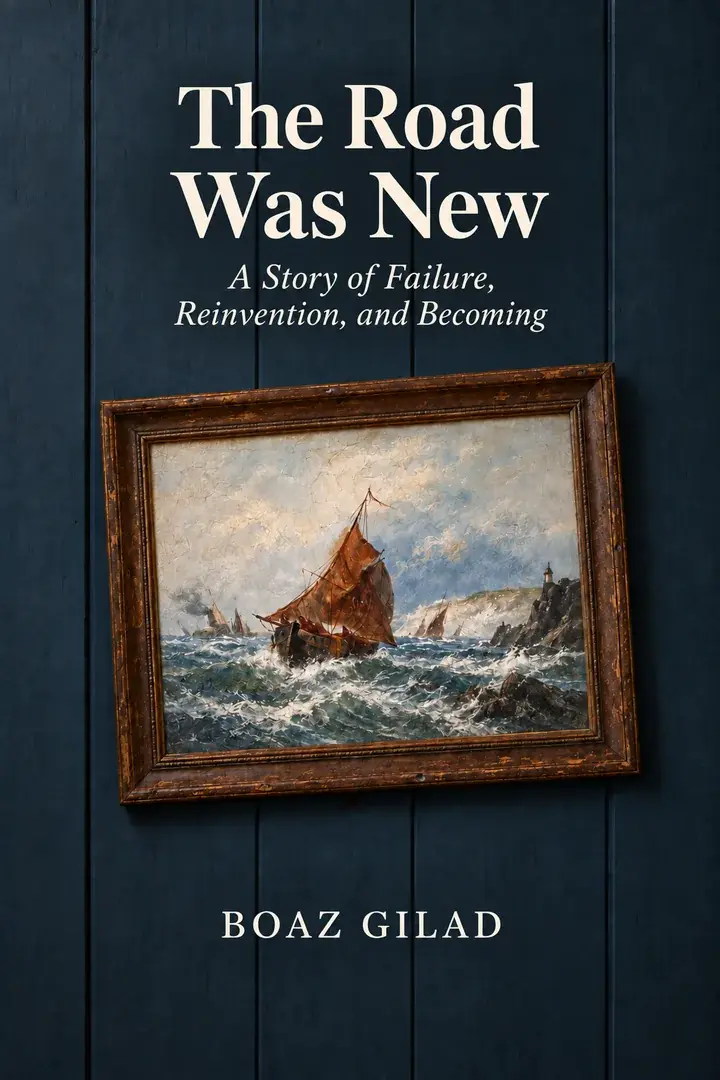
The Road Was New: A Story of Failure, Reinvention, and Becoming is Boaz Gilad's forthcoming memoir, coming in November 2026. It is about rebuilding after failure, reclaiming your direction, and the move that changes everything. Join the list to hear when it is ready, or start now with The First Move, a free guided exercise from the book.
Inside the memoir
What is the story about?
- 01
Failure
What it is like when the plan breaks and the identity built on it breaks too — told honestly, including the uncomfortable parts.
- 02
Reinvention
How you rebuild after failure: reclaiming your direction instead of waiting for it to return.
- 03
Becoming
The move that changes everything — and why it usually starts smaller than people expect.
From The Performance File
Essays on starting again
On Loss
Prompted by hearing a grieving father speak about his deceased son, Gilad reconsiders the common phrase 'I'm sorry for your loss,' questioning whether what we love is ever truly 'lost' or whether it changes form and continues to shape who we become. Without minimizing the genuine pain of grief, he argues that fixating only on what is gone, rather than also on what remains or has been transformed by the experience, can trap people in unproductive suffering. The essay encourages readers to consider their own losses—relationships, opportunities, versions of themselves—and ask what that loss left behind: a memory, a skill, a scar, a new direction, a deeper compassion, or a clearer personal standard. Gilad proposes a concrete written exercise: naming one way the loss can serve the person's life today without pretending the pain isn't real, which might mean a conversation that needs to happen, a decision, a boundary, or an action rooted in the lesson of what was lost. He closes by reframing the work of a 'Top Performer' facing loss as learning to use what remains rather than fighting endlessly only for what was.
Read the summaryOn Becoming
Gilad examines the disorienting moment after a major goal is achieved—a completed project, a transformed body, a stabilized business—when the natural question isn't just 'what's next' but a deeper one: 'who am I now?' He argues that behind every visible outcome, a second, quieter game was always underway: not just producing a result, but developing a mind and character capable of sustaining higher performance. High achievers often mistakenly believe winning the game is the goal, when it is really just the entry point; the deeper aim is becoming someone capable of playing increasingly meaningful games with more clarity, courage, and freedom. Gilad cautions that even 'becoming' must be handled carefully, since an obsessive focus on self-transformation can itself become another trap or performance rather than genuine growth. He closes with a structured set of questions covering the self, relationships, business, creativity, money, and purpose, urging readers to identify the first concrete move—call, conversation, boundary, workout—reminding them the point of the game is not only to win or become, but to become without losing the capacity to simply be.
Read the summaryOn the Unknown Game
Gilad introduces a foundational idea underpinning much of his other writing: life is not a single pursuit but many simultaneous games across different domains—health, business, relationships, finances—each with its own rules, incentives, and costs, and participation in all of them is mandatory even if people don't consciously realize it. The central distinction he draws is not whether you're playing these games, since you always are, but whether you're playing them consciously, with intention, or unconsciously, letting default habits and avoidance set the outcome by default. The essay argues that an honest, even painful, accounting of where you currently stand in each domain is the necessary starting point before any meaningful improvement can occur, since your life is already generating results and keeping score whether or not you're paying attention to it. Gilad closes with a practical commitment device: choosing one specific weekly action in an area that has been neglected or abandoned, scheduling it in a calendar, and following through consistently for four weeks, explicitly framing it as a beginning rather than a dramatic reinvention or performance of change.
Read the summaryQ&A
Questions about the book
Invitation only
The room changes you.
Zenith is invitation-only. Every application is read personally.