01
Choose the Game
Focus on the activities that compound.
Book
Winning the Games That Matter
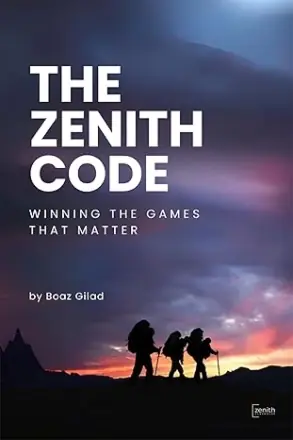
The Zenith Code is Boaz Gilad's performance framework for leaders who work hard but spend their effort on the wrong games. It shows how to choose the activities with compounding returns, turn failures into fuel, build the habits that make performance repeatable and lead a room to do the same.
The framework
01
Focus on the activities that compound.
02
Pull the lesson out of setbacks fast.
03
The habits and rhythms behind consistent performance.
04
Scale the principles across a team.
Business owners, founders, executives, senior leaders and high-performing professionals.
The Zenith Code is the foundation of the Zenith Clubhouse programs and Boaz's keynotes.
Core ideas
Hard work spent on the wrong games is still wasted. The book starts with deciding which activities compound, and which only keep you busy.
Setbacks are data. The faster you pull the lesson out of a failure, without self-judgment, the faster performance improves.
Consistent performance comes from habits and rhythms, not bursts of motivation. The code is the personal operating system that holds under pressure.
Once the principles work for you, they scale: clear standards and accountability across a team.
From The Performance File
Gilad challenges the common assumption that life consists of separate, sequential victories—win the business game, then relax; fix the body, then move to relationships—arguing instead that all of life's 'games' are interconnected, and success in one area while neglecting the system that supports it quietly undermines long-term performance. The essay frames top performers as people who understand that the long game is already underway, not a future event to prepare for, and that today's seemingly minor choices in health, relationships, and finances are training ground for challenges that haven't yet arrived. Gilad provides specific example commitments—quality time with a partner without devices, weekly financial review, morning journaling, leaving work at a set hour—as concrete ways to invest in the interconnected system rather than a single isolated goal. He asks readers to identify which current challenge is secretly training them for a future game and to act on that insight immediately rather than deferring it. The piece closes by replacing the common delaying thought 'I'll handle it later' with the reminder that today, not later, is where top performers actually train.
Read the summaryGilad reframes 'what industry am I in' by proposing that everyone is really in the high-tech business, where high-tech is defined not by appearance (laptops, startups, modern offices) but by R&D intensity—the share of resources devoted to research and experimentation, citing an OECD/JRC threshold of above 7%. Under this lens, a company or person can look modern yet be culturally defensive and resistant to testing new ideas, while a very ordinary business or life becomes 'high-tech in spirit' by committing real resources to experimentation and improvement. He extends this to personal domains: body, relationships, leadership, and business all benefit from treating life like a lab that runs small, structured experiments rather than repeating the same routines and hoping for different results. The piece ends with a concrete framework of questions, including defining a near-term experiment small enough to complete, specifying what would count as learning (not just success), and scheduling a review—because, as Gilad states, R&D without review is just activity. He urges starting the 'lab' immediately rather than waiting for ideal conditions.
Read the summaryBuilding on his recurring theme that life consists of endless, parallel games, Gilad focuses on the uncomfortable truths embedded in the word 'game' itself: games have rules, constraints, winners, losers, and definite endings, some arriving gradually through neglect and others abruptly without warning, with timing that isn't negotiable. The piece pushes readers to confront whether they are actually winning in the specific areas of life that matter most to them, rather than assuming general busyness or effort equates to success. Gilad guides a concrete exercise: listing the three most important areas of one's life, honestly assessing whether one is currently winning in each, and then vividly describing—as if narrated in a documentary—what genuine winning in those areas would actually look like in detail. He then has readers quantify the gap between their current state and that vision on a 1–10 scale, before committing to three specific actions per area for the coming week designed to move the needle by just one notch. The essay's core message is that meaningful progress in life's most important games comes from small, deliberate, immediate weekly action rather than sweeping aspiration.
Read the summaryQ&A
Invitation only
Zenith is invitation-only. Every application is read personally.